
My Daughter Turns 6 This Week. She Has Never Not Known She Is Donor Conceived.
Published to mark International Donor Conception Awareness Day, 27 April 2026. #IDCAD
When my daughter was three, she told a man at the bus stop — completely unprompted, with the full confidence of someone stating a perfectly obvious fact — that she doesn't have a dad. She has a donut.
He was reading his newspaper. He looked up, blinked, and said "oh, right." She went back to her snack.
That was it. No drama. No confusion. No sadness. Just a small person telling her story in the same matter-of-fact way she'd tell you her name or her favourite colour.
She turns six this week. And in her whole life, there has never been a moment where she learned she was donor conceived. Because she has always known. It has always just been her story.
This week — International Donor Conception Awareness Day — I want to talk about what that actually looks like. Not as a guide or a how-to. But as proof that this can be easy. Joyful, even. And that the "difficult conversation" most parents dread is only difficult if you wait until it feels like a revelation.
It doesn't have to be a revelation. It can just be Tuesday.
She has never not known
I started talking to my bump before she was born. "We had help from a donor to make you. I wanted you so much." I read her books that showed families like ours. By the time she could speak, she already had the words.
She doesn't have a complicated relationship with her story. She has a clear one.
She knows she doesn't have a dad. She knows she has a donor. She knows she has a little sister who lives in a different house with a different mummy — because they used the same donor. She knows our family is just two of us (and a dog, and a cat, and a full dance floor in our kitchen whenever the right song comes on).
She doesn't feel different because she isn't different. Not in the world she lives in.
The world she lives in
Yesterday we spent the afternoon with eight other solo mums. Some had children around my daughter's age. Some are just starting treatment. Four had babies under one year old — tiny new humans who are already, without knowing it, growing up in a community that sees them.
My daughter ran around with the other kids. The babies got passed around and cooed over. The mums talked about what mums talk about. It was completely, entirely ordinary.
That's the gift of community. Not just for us — for them. Our children grow up seeing that their family isn't unusual or rare. It's just one of many ways a family is made. Some have two mums, some have two dads, some have a mum and a stepdad, some are just a mum and a child with a dog who thinks he's also a child.
All families are perfect, just the way they are.
(That's the last line of My Perfect Family. I wrote it for my daughter. I believed it when I wrote it. I still do.)
The book on her shelf
When I wrote My Perfect Family, I wasn't trying to explain donor conception to children. I was trying to show every child — not just mine — that their family is normal.
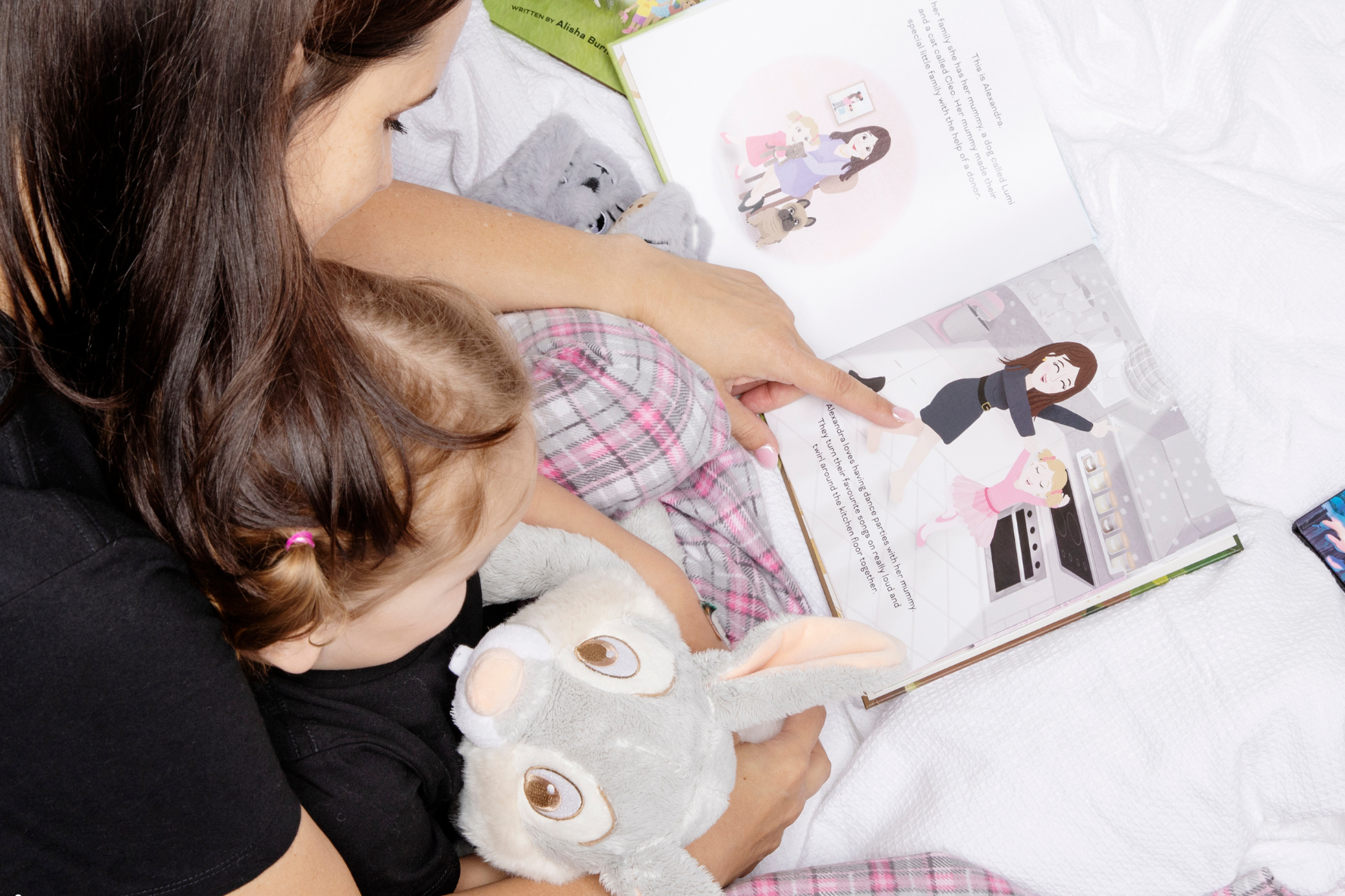
The book has twelve families in it. Lucas has a mummy and daddy and a new baby sister. Charlotte has two mummies who had help from their donor friend James. Sam has two dads and a famously fat cat called Boris and they go on beach holidays together. Sophia lives with her Nonna and Nonno and has the best Sunday dinners. And Alexandra — my daughter's family — has a mummy, a dog called Lumi, a cat called Cleo, and they love having kitchen dance parties together.
My daughter has always been able to point to Alexandra and say: that's us.
That's what it means for a child to see their family in a book. It's not about explaining anything. It's about reflecting something. It says: your family exists. Your family is here. Your family is loved.
If you're pregnant with a donor-conceived child, or you have a little one at home — this is one of the simplest, most powerful things you can do. Put books on their shelf that look like them. Read them regularly. Not on a special occasion, not as a conversation-starter. Just as bedtime reading, in the same pile as everything else.
What the conversations look like now, at nearly six
The conversations have changed as she's grown. At two she accepted the words. At three she said them back, including to strangers on public transport. At four she started asking more specific questions — about the donor, about her sister, about why some families have dads and ours doesn't.
At nearly six, she can confidently explain her whole story. She knows she has a donor. She knows her sister in another family came from the same donor, which makes her a donor sibling — a person who is connected to her in a special way even though they have different mums. She knows she was wanted so much that her mum did something brave and intentional to bring her into the world.
None of these conversations have been hard. Because none of them were ever a secret that needed to come out. We've been having them since before she could talk. Each new conversation is just a new layer on something she already knows and owns.
The research backs this up. Children who are told early — from infancy, in age-appropriate language — have stronger trust in their parents, healthier identity development, and less of the confusion that comes from late disclosure. They don't feel betrayed, because there's nothing to be betrayed by. There's just their story, told honestly, for as long as they can remember.
If you're still in the early stages — start now
If you're pregnant, start talking to your bump. Use the words: donor, not daddy. Say them out loud until they feel easy and ordinary, because the goal is for them to feel easy and ordinary.
If you're in the TTC or planning stage and wondering how you'll ever explain this — the honest answer is that you won't ever "explain" it if you do it right. There won't be a day when you sit your child down and have The Talk. There will just be hundreds of small, normal conversations that have been happening since the beginning.
That's the goal. Not a big reveal. Just a story that's always been theirs.
The community that makes it possible
My daughter has never felt alone in her story because she has never been alone in her story. She has grown up surrounded by other families who look like ours. Other solo mums, other donor-conceived children, other people who understand without explanation.
That community doesn't happen by accident. You have to build it deliberately, especially when your child is small. The women we sat with yesterday are part of my daughter's village. Their babies will grow up knowing my daughter's name. And one day, those babies will be confidently telling people at bus stops their own version of the story.
That's what I want for your family too.
If you're pregnant or parenting a donor-conceived child and you'd like to connect with women who get it — The Bump Membership and the Solo Mum Society community are here.
And if you'd like books for your child's shelf that reflect their family — at every age, with community ratings and honest reviews — I've put together a free children's book list you can download below.
Happy International Donor Conception Awareness Day. 💛
To every donor-conceived child: you are so wanted. You are so loved. Your family is perfect, just the way it is.
Alisha x
#IDCAD #DonorConception #SoloMumByChoice #DonorConceived #SoloMumSociety