
“She doesn’t have a Dad. She has a Donor.”
What happened during family week at school — and what I learned about how to actually support your donor-conceived child when the world hasn't caught up yet.
It was Monday afternoon pickup.
My daughter came out of school and I could see it on her face before she reached me. That particular look — somewhere between frustrated and deflated — that tells you something has happened that she doesn't quite have the words for yet.
It was family week at school. They'd been doing activities about their families, talking about who lived at home, drawing pictures. And some of the other children had decided that my daughter must have a dad.
Not that she might. That she must. And since she kept telling them she didn't, the only logical explanation — to a group of six-year-olds working from a very limited frame of reference — was that he must be dead.
"Why doesn't anyone understand our family, mummy?"
She knew exactly who she was. They just didn't have the language yet.
Here's the thing that struck me as she told me what happened: my daughter handled it beautifully. She told them she doesn't have a dad. She has a donor. That her mum had her all by herself.
She wasn't confused. She wasn't ashamed. She was just... exhausted by the argument. Because no matter what she said, they couldn't accept it. Not because they were being unkind — they genuinely just couldn't compute a family that looked different to theirs, because they'd never encountered one before.
This wasn't the first time. Last year, a friend told her she was lying. That she does have a dad, he just lives in a different house. That one came from the parent — who, despite being corrected, still insists on calling her donor "dad." When I explain that a donor isn't a dad, that "dad" is a parental role rather than a genetic one, I'm told: "same thing."
It isn't. And the distinction matters — not just semantically, but because the word "dad" implies something is missing. A parent who should be there but isn't. That's not our story. We don't have a missing dad. We have a donor, and a family that is exactly what it was always meant to be.
We've since distanced ourselves from that family. Not dramatically, but deliberately. Because when someone consistently refuses to use the language that reflects your child's reality, they are — however unintentionally — telling your child that their family is wrong.
Most families haven't had to have this conversation yet.
I think it's easy, when you're in this community, to forget how unusual our families still are to most people.
We are surrounded by it. Donor conception, solo motherhood by choice, intentional single-parent families — this is our normal. Our children grow up knowing their story. They know what a donor is. They understand that families are made in all kinds of ways.
But most six-year-olds haven't encountered a donor-conceived family yet. Most parents haven't had to explain it to their children — not because they're unwilling, but because it simply hasn't come up. You don't tend to have conversations about family diversity that your own life hasn't required you to have.
And schools reflect that. Teachers are doing their best with thirty children and a curriculum that still largely assumes a fairly traditional family structure — not out of malice, but out of the reality that most classrooms don't have many families that look like ours. Yet.
That's changing. But we're still in the in-between.
What I did — and what actually worked.
After the conversation with my daughter on Monday, I did two things.
First, I talked with her about what happened and made sure she felt understood and proud of how she'd handled it. She had responded well. She'd stood her ground, told her story clearly, and come to me when it got too hard to argue alone. That matters.
Second, I sent an email to her teacher.
Her teacher knows our story — I'd shared it at the start of the year. But a teacher can't address something she doesn't know is happening. I explained what my daughter had experienced, the specific language the other children were using, and asked if there was any way to use family week as an opportunity to gently broaden the conversation about what different families look like.
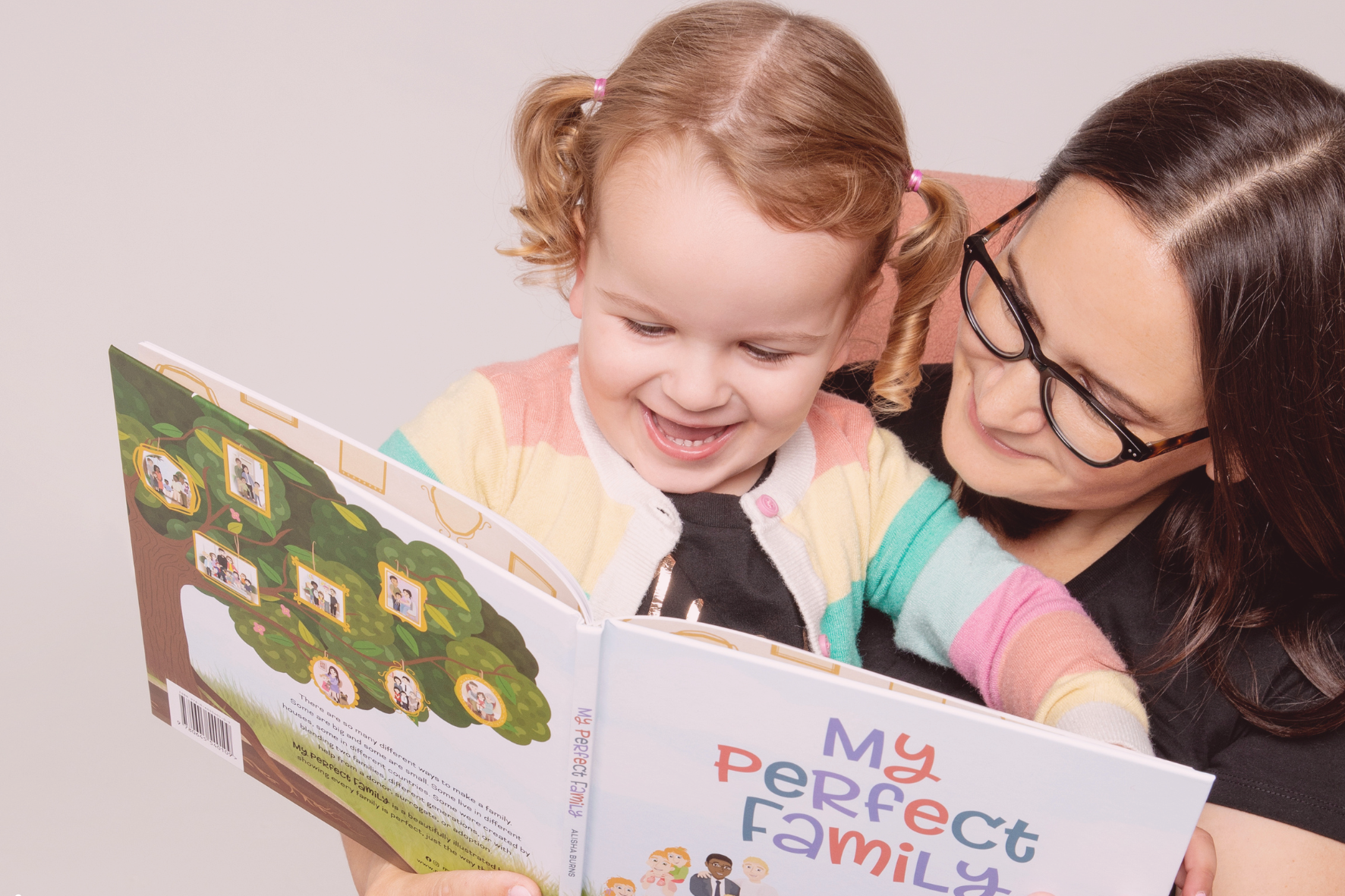
I also sent My Perfect Family to school with my daughter.
My teacher read it to the class. By the end of the week, something had shifted. My daughter came home lighter. The children who hadn't understood — did. And one little girl came up to my daughter and apologised.
That apology meant everything.
Practical advice for navigating this with your own child
If you're in this stage — your donor-conceived child is at school, or heading there, and you're wondering how to set them up for the conversations that are coming — here's what I'd suggest.
Start at school before it becomes an issue. Don't wait for something to happen. At the beginning of each school year, have a brief conversation with your child's teacher or send them an email using the teacher template as a start point. You don't need to make it a big deal — a short email or a quiet word at pickup is enough. Explain your family structure in plain terms, share the language you use, and let the teacher know they can come to you with questions. Teachers want to support your child. They just need the information to do it.
Send a book. A children's book that reflects diverse families is one of the most practical things you can send to school. Not a "how babies are made" book — something that simply normalises the fact that families look different. My Perfect Family was written specifically for this: it shows all kinds of families without making donor conception a clinical explanation. It gives teachers a natural, non-awkward way to open the conversation with a whole class.
The children's book list I've curated has books for every age and approach — some that explain donor conception directly, some that simply celebrate different family structures without going into conception at all. Both have their place. The latter is often more useful in a classroom setting because it doesn't require any child to disclose more than they want to.
Help your child know how to explain it in a way other kids can hear. Our children often know their own story very well — mine certainly does. But knowing your story and being able to explain it to a six-year-old who has never heard the word "donor" are different skills.
It's worth practising simple language with them. Not a speech — just a line or two. Something like: "I don't have a dad. My mum really wanted a baby, so a doctor and a person called a donor helped her, and that's how I was born." Keep it matter-of-fact. The calmer and simpler it sounds, the more easily other kids accept it.
Correct language gently but consistently. When other adults — parents, family friends, teachers — use the word "dad" for your donor, correct it. Warmly, briefly, without making it a confrontation. "She doesn’t have a dad, I used a donor" And if someone pushes back, hold the line and explain to them that language does matter, that “dad” is a parental role, and by saying “dad”, it’s implying there’s a parent somewhere who isn’t in her life, and that’s not the case. Your child is watching how you handle it. If you let it slide, they learn that the language doesn't matter. It does.
Know that your child's confidence is your most powerful tool. My daughter didn't need me to fight her battle. She needed me to support her after she'd fought it herself. Children who grow up with a clear, positive, shame-free story about their origins are remarkably resilient in these moments. They might be tired of explaining. They might be frustrated. But they are not confused about who they are.
That groundwork is laid at home, over years, through the conversations you have and the books you read and the way you talk about your family like it is — normal, whole, and exactly right.
And when other children don't understand — it's almost never cruelty. It is almost always just... a gap. A gap that the adults in their lives haven't had reason to fill yet. Our job isn't to be angry at those children or their parents. It's to gently and consistently help fill that gap — one conversation, one book, one corrected word at a time.
The world is catching up. We just have to keep going.
More families like ours exist every year. More children are growing up donor-conceived. More schools will have more than one family that looks like ours. The conversations are becoming more common, the language is spreading, the books are being written.
We're just still in the early part of that shift. And until the world catches up, our children need us to hold the line — calmly, warmly, and without apology.
My daughter went back to school, and by Wednesday she was happy. The kids understood. The teacher had helped.
That's all it took. A conversation, a book, and someone willing to use it.
Two things that can help:
My Perfect Family is the book I sent to school that week — written specifically to introduce children to diverse families without making it a birds-and-bees conversation. Available in hardcover, softcover and multiple languages.
And the children's book list which is a great list of books for donor-conceived children — rated and reviewed by solo mums in this community.
👉 Download the free children's book list
A note: this list was last updated in 2024 and I know there are more books that deserve to be on it — including some brilliant new ones. An updated version is coming very soon. In the meantime, everything on this list has been read and rated by real solo mums in this community, and it's still a genuinely useful starting point.
Alisha Burns is the founder of Solo Mum Society and a solo mum by choice. Her daughter was conceived via donor conception and born in 2020. Solo Mum Society is Australia's leading community for women choosing solo motherhood by choice.